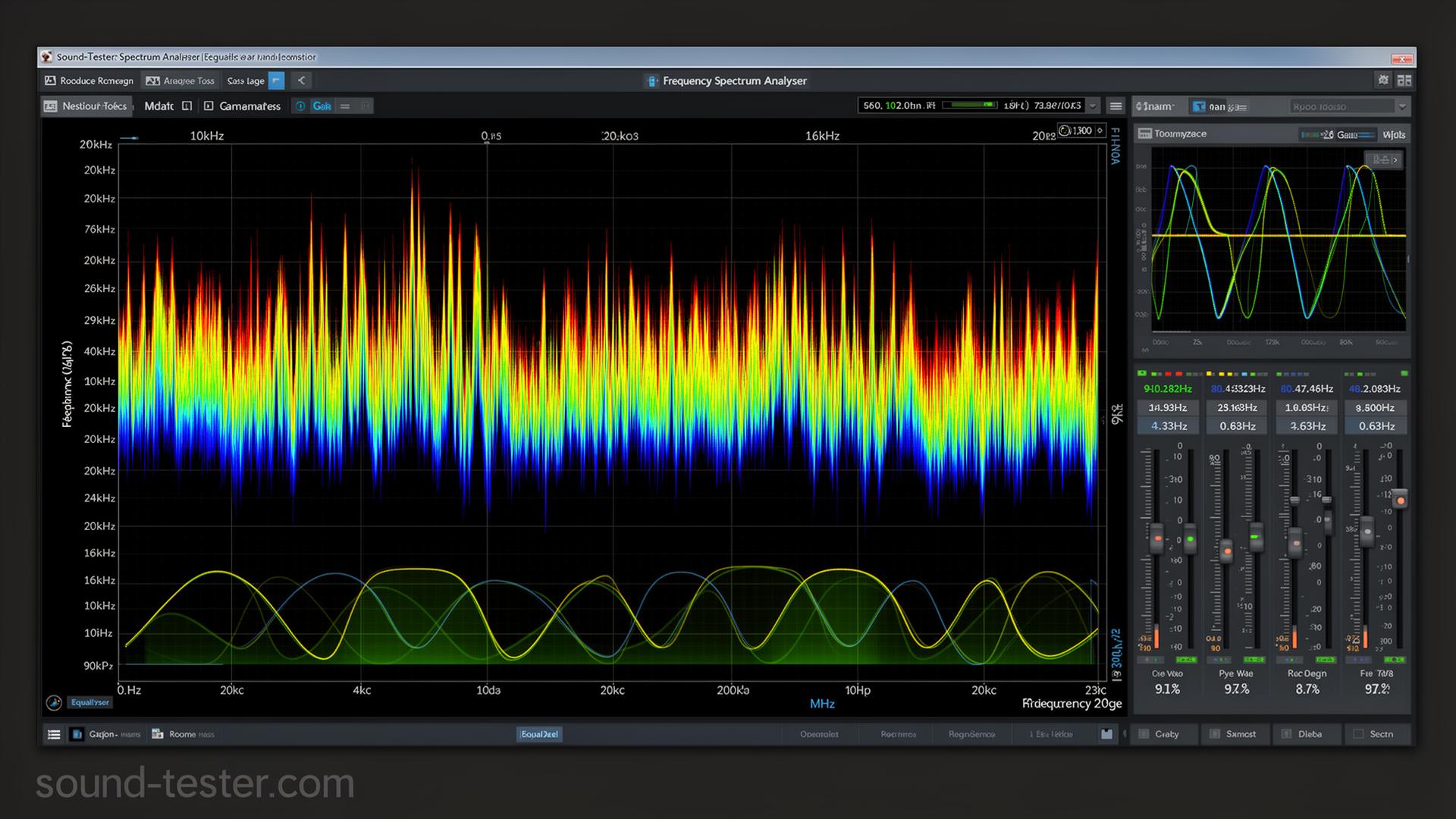
What's a Frequency Test and Why Should You Care?
Ever wonder why some sounds come through crystal clear while others seem muffled or missing? That's frequency response at work. Our frequency test plays pure tones across the entire audible spectrum so you can hear exactly what your equipment (and your ears) can handle. If you want to focus specifically on bass, try our bass test which zooms in on those low rumbles.
The Sound Spectrum, Explained Simply
Human hearing covers roughly 20Hz (very deep bass, more felt than heard) to 20,000Hz (super high pitched, kids hear this better than adults). Everything you hear falls somewhere in between. Sub-bass lives in the 20-60Hz range. Regular bass is 60-250Hz. Mids are where vocals and most instruments hang out. Highs add sparkle and detail. Each piece matters for the overall sound.
Testing Your Hearing Range
Start at 1000Hz since pretty much everyone can hear that easily. Then slide toward the extremes and see where things fade out. Most adults can hear down to about 20-30Hz and up to 15-17kHz. If you can't hear certain frequencies, don't panic! Make sure the volume is reasonable first (some frequencies need more power to be audible), and remember that our hearing changes as we age. Check your listening level with our sound level meter.
Testing Your Equipment
Different audio gear handles frequencies differently. Big speakers and quality headphones usually cover the full range. Smaller speakers and earbuds often struggle below 50-80Hz. That's just physics (tiny drivers can't push enough air for deep bass). This test shows you exactly where your equipment's limits are. It might not match what the box says, and that's useful to know.
Listen for Problems
As you sweep through frequencies, keep your ears open for anything weird. Buzzing at low frequencies? Might be a loose speaker part or something on your desk vibrating. Harsh sounds at high frequencies? Could be driver damage or your amp struggling. Rattling at any point is never normal. Time to investigate.
Be Kind to Your Ears
Quick safety note: high frequencies at high volumes can hurt. Very low frequencies can feel physically uncomfortable. Always start quiet and turn up gradually. If anything feels unpleasant, turn it down immediately. Your hearing is precious, so don't sacrifice it for a test. Take breaks if you're testing for a while.
Real-World Uses
Beyond troubleshooting, frequency generators are genuinely useful tools. Musicians use them for tuning and ear training. Audio engineers check speaker response in different rooms. Content creators verify their monitoring setup before recording. Pair this with our mic test for a complete setup check. For stereo balance, add our headphone test.
About Age and Hearing
Here's a fact of life: high-frequency hearing naturally declines as we get older. By 50, most people have lost sensitivity above 12-15kHz. This is completely normal and doesn't really affect music enjoyment. Most of the good stuff happens below 10kHz anyway. So if you can't hear the super high frequencies, welcome to the club. Your hearing is probably fine.
Common Questions
I can't hear anything above 14kHz. Should I be worried?
Honestly, no. High-frequency hearing drops off naturally with age. By 30 most people lose 17-20kHz, by 40 it's around 15kHz, and that's just normal. It rarely affects music enjoyment because most musical content lives below 10kHz. Worry only if you've suddenly lost frequencies you used to hear.
My speakers go silent at certain frequencies in the middle of the sweep. What's happening?
Two possibilities. One, your room is creating cancellation nulls at those frequencies (common with bass and lower mids). Two, your speakers have a real dip in their response. Try moving your head a few inches in any direction during the sweep; if the dip moves with you, it's the room, not the speakers.
Some frequencies sound much louder than others. Is my equipment broken?
Probably not. No speaker or headphone has perfectly flat frequency response, and human hearing itself is uneven (we hear midrange better than the extremes). Big consistent peaks or dips could indicate a problem, but small variations are normal and expected.
I hear a buzzing or distortion at specific frequencies but not others. Why?
That's usually a resonance, where something physical vibrates at that exact pitch. Could be a loose screw on the speaker, a panel in your room, or even an object on your desk. Move things around during the problem frequency to find the culprit.
Are these tones safe to listen to?
At moderate volume, yes. High frequencies and pure tones can be fatiguing, and very high volume can damage hearing fast. Keep the volume low, especially when testing high frequencies, and take breaks. If a tone hurts, stop immediately.

